
REVIEW · GREECE
Heraklion: Basic Diver for Beginners
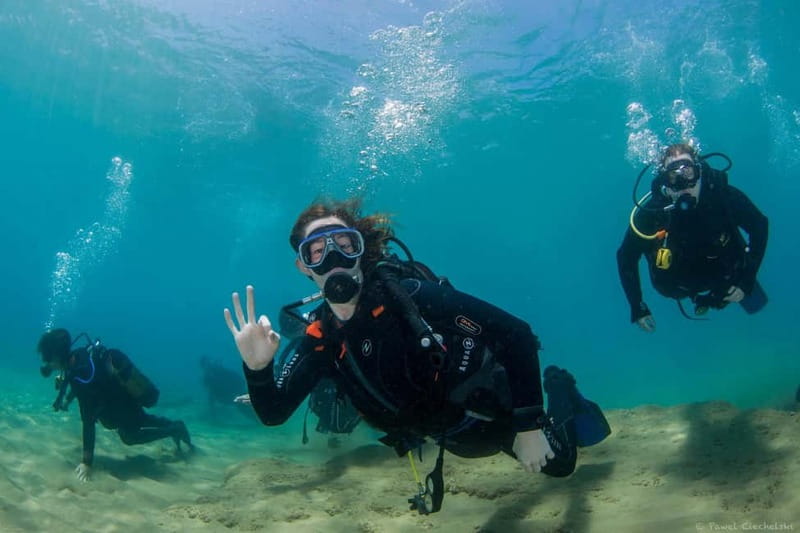
The memorable part comes quickly: you breathe underwater for the first time, then move around Agia Pelagia with an instructor close by. I like the small groups, limited to six people, and the careful progression from a 30-minute lesson to shallow-water practice and then a 45-minute open-water session. I also like that the $100 price includes equipment, insurance, instruction, and transfers from many nearby resorts.
The main catch is that this is not suitable for non-swimmers or anyone with several listed health concerns, including respiratory or heart problems, epilepsy, a current cold, or recent surgery. A previous illness also affected one participant’s ability to finish, so be honest about your health before booking.
Key points to know before you book
- You reach up to 10 meters: The open-water session lasts about 45 minutes, depending on your comfort and instruction.
- The lesson starts on land: Expect about 30 minutes of basic instruction before handling the equipment in water.
- You practise before going deeper: Skills are introduced in a pool or shallow water in front of the center.
- Groups stay small: There can be no more than six people on the course and no more than four students per instructor.
- Morning pickup is included: Transfers cover many resorts around Heraklion, with the return beginning at 4 p.m.
- Photos cost extra: HD pictures and video are not part of the $100 package.
Your first underwater breath in Agia Pelagia
Basic Diver is designed for the moment when you want to try scuba but do not want to commit to a full certification course. You learn the essential ideas, put on a complete set of equipment, and spend time below the surface under direct supervision.
That first breath through a regulator can feel strange. The program gives you time to get used to it rather than rushing straight into open water. The short theory session explains the basic principles of scuba and how to use the mask, fins, buoyancy control device, regulator, weights, and tank.
I like this order. You first hear what the equipment does, then practise simple skills in controlled conditions, and only after that move into the sea. For a first attempt, that makes the experience feel manageable rather than like a sudden leap into unfamiliar water.
The course is also useful if you have tried scuba before but want a gentle refresher. It is not a qualification, though, and the information provided does not describe it as a route to certification. Think of it as a supervised introduction.
More beginner dives in Greece:
- Santorini: Scuba Diving Experience in Caldera for Beginners
★ 4.9 · 597 reviews - Heraklion: Scuba Diving Experience for Beginners _Beach
★ 4.7 · 549 reviews - Heraklion: Beginner Scuba Diving Lesson with PADI Instructor
★ 4.9 · 355 reviews
The 30-minute lesson and equipment setup
The first formal section takes about half an hour. You learn the basic rules of scuba and how to use the equipment required for the session.
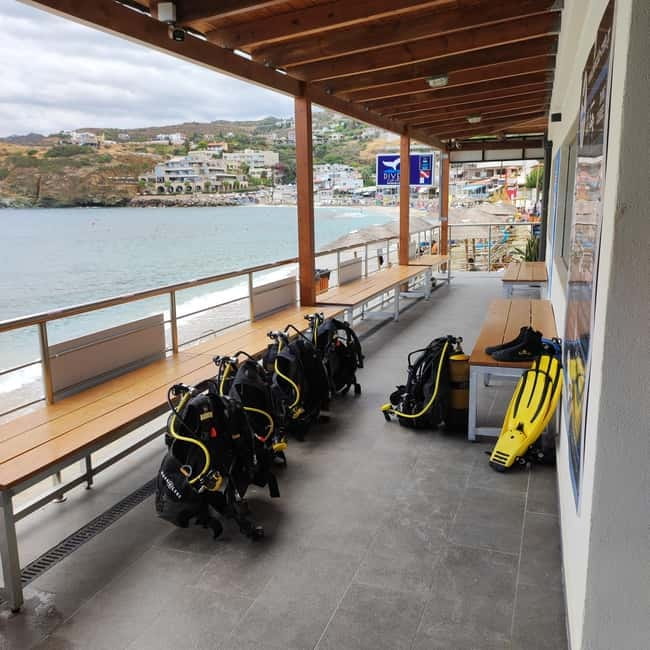
The included kit is extensive. You receive a mask and snorkel, fins, a buoyancy control device, regulator, tank, weights and belt, and a wetsuit. Both shorty and 5mm wetsuit options are listed, along with full-foot and open-heel fins. The exact choice of equipment can depend on fit and conditions, so bring beachwear and a towel.
The provider also includes eLearning. That gives you another way to review the basics, though the supplied information does not specify when you complete it or how long it takes. You should still expect an in-person explanation before getting into the water.
Instruction is available in French, English, Greek, and German. One participant specifically praised an instructor named Stan for clear explanations and calm support. Another described a French instructor as especially helpful. Staff assignments can vary, but those details suggest you can ask for the language that suits you best when arranging the session.
Shallow-water practice before the sea
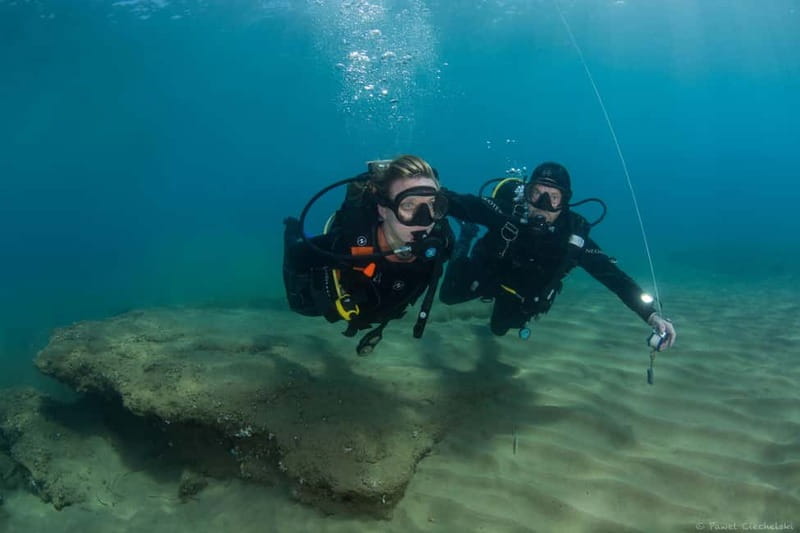
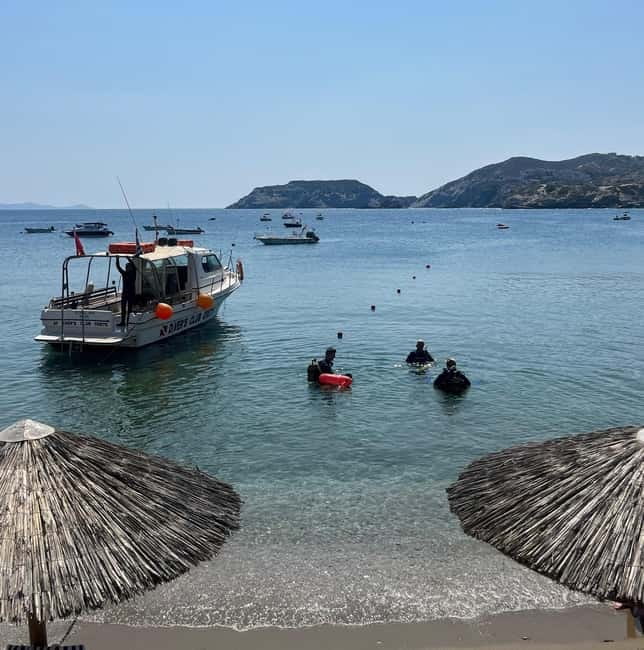
After the introduction, you practise a few basic skills in a pool or in the shallow water in front of the center. This is one of the most useful parts of the program, because it lets you deal with the mask, regulator, fins, and buoyancy equipment before heading farther out.
The word basic matters here. You are not expected to perform a long list of advanced skills. The goal is to become comfortable breathing through the regulator and moving with the equipment while an instructor watches closely.
This stage can also show you how you feel underwater. Some people settle in quickly. Others need extra time with breathing, clearing the mask, or adjusting their position. The small student-to-instructor ratio helps here: no more than four students are assigned to one instructor, even though the full course can hold up to six participants.
That limit is important for a first underwater experience. You are less likely to feel lost in a large group, and the instructor has a better chance of noticing when you need help. It also means the pace can be shaped around the people in that particular session.
The 45-minute open-water session
Once you have practised in controlled water, the program moves into the open sea. The session lasts about 45 minutes and reaches a maximum depth of 10 meters.
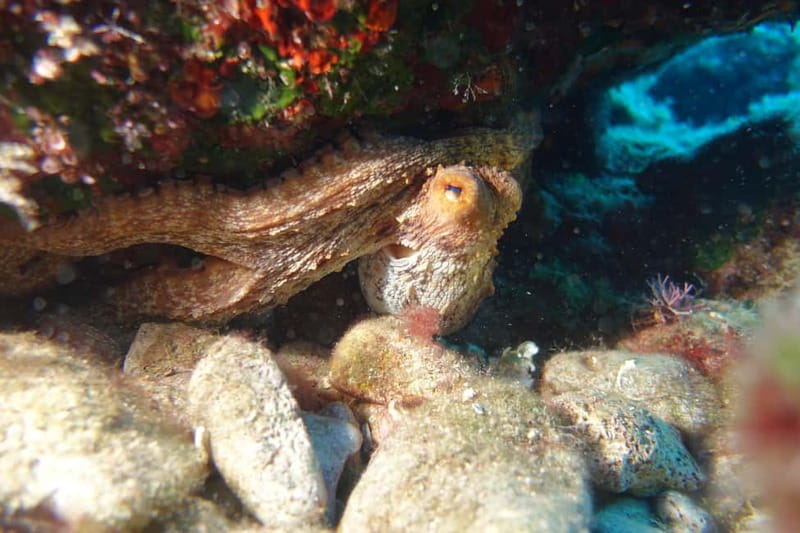
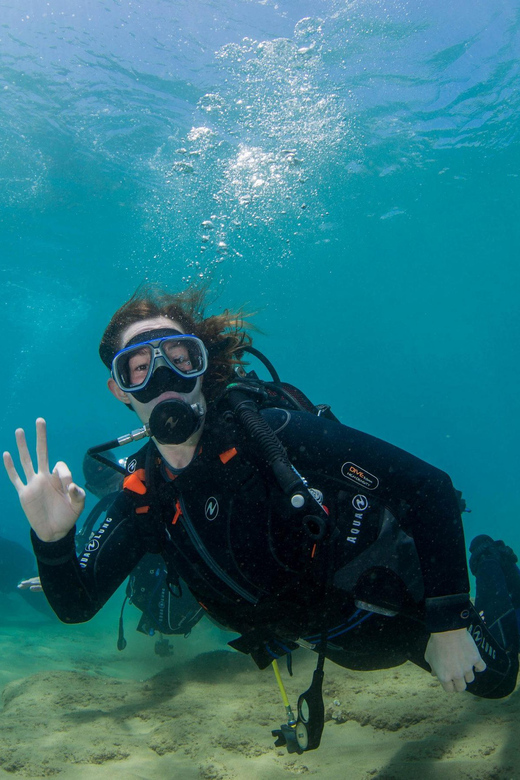
Ten meters is enough to give you a real sense of being below the surface without turning this into an advanced expedition. You can swim freely, but you remain under the supervision of a qualified instructor. The supplied details do not promise a specific route, reef, wreck, or marine species, so book this for the experience of breathing underwater and moving through clear coastal water, not for a guaranteed wildlife checklist.
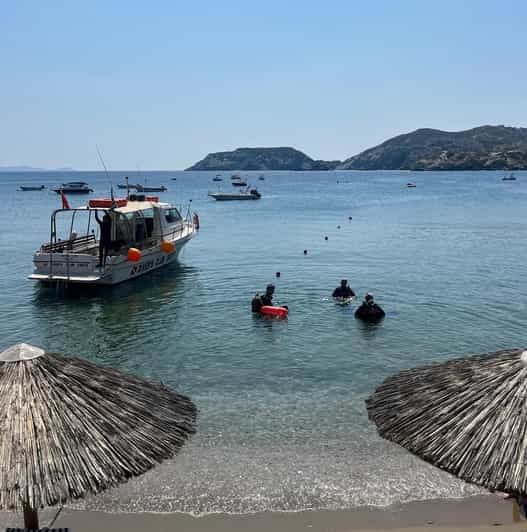
The setting is Agia Pelagia, a coastal area used for the underwater portion of the activity. One participant described the water as clear and the location as well suited to an introduction. Conditions can vary, of course, and the precise experience depends on the sea, weather, and your comfort.
The session is long enough to feel worthwhile. A short trial can end just as you are becoming comfortable, while 45 minutes gives you time to settle into the equipment and enjoy moving under the surface. If this is your first time, the opening minutes may feel busy as you focus on breathing and instructions. The later part should feel more natural if you relax into the rhythm.
A few more dives around Greece worth comparing
- (Full day)Scuba Diving in Rhodes
★ 5.0 · 466 reviews - Rhodes: Diving Adventure for Beginners and Experts
★ 4.6 · 237 reviews - Try a DIVE, discover scuba diving in Mykonos
★ 5.0 · 216 reviews - Heraklion: Scuba Diving Experience for First-Timers
★ 4.8 · 203 reviews
What the three to six hours really involves
The activity is advertised as taking three to six hours, with the core program taking about three hours. The longer total reflects transport and the time spent around Agia Pelagia.
The schedule runs twice daily, at 9:30 a.m. and 12:45 p.m. Pickup and drop-off arrangements can affect the total time, especially if you are staying outside Agia Pelagia. The stated itinerary includes about an hour in the van each way, followed by the three-hour water program and free time.
The practical sequence looks like this:
- Pickup from an eligible hotel or meeting point
- Van transfer to Agia Pelagia
- Basic instruction and equipment preparation
- Pool or shallow-water skills practice
- About 45 minutes in open water
- Free time and snorkeling around the center
- Return transfer
The free time is a nice touch. You are not rushed straight from the underwater session into the van. You can snorkel or simply stay by the water, though the supplied details do not specify how long that break lasts.
The schedule is best for a morning plan. Transfers are offered in the morning only, and the return to your hotel or pickup point starts at 4 p.m. That makes it a poor match for a tightly packed afternoon appointment, ferry connection, or evening flight.
Pickup from Heraklion and the resort coast
Free transport is included from many areas, including Heraklion, Agia Pelagia, Ammoudara, Analipsi, Anissaras, Fodele, Gouves, Hersonissos, Karteros, Kokkini Hani, Koutouloufari, Lygaria, Made, Malia, Mononaftis, Piskopiano, and Stalis.
The listed pickup points also include Xeropotamos, Kato Gouves, Limenas Chersonisou, Paralia Fodele, and the wider Gouves area. Because pickup service is tied to specific areas, confirm your exact hotel or meeting point before relying on the transfer.
For you, the transport adds real value. A taxi or rental car can make a short activity more expensive and less convenient, especially if you are staying along the north coast. The tradeoff is time. Shared transport can stretch the day, and the itinerary allows roughly an hour each way for the van.
If you are staying in Agia Pelagia, you may have the simplest day, since that is where the water program takes place. If you are based farther east, such as Malia or Stalis, expect the transfer to become a larger part of the outing.
What the $100 price includes
At $100 per person, this is a reasonable first-time scuba experience because the main costs are already covered. You receive a qualified instructor, confined-water practice, one open-water session, full scuba equipment, wetsuit, weights, tank, refreshments during the surface break, and DAN diving insurance.
The equipment rental alone would make a self-arranged attempt impractical for most beginners. You also avoid paying separately for a pool session, instructor time, and transport if you are staying in one of the covered areas.
The package does not include HD photographs or video. That is worth noting because underwater pictures are often an important part of a first scuba experience. If you want photos, ask about the extra cost before the session rather than assuming a camera package is included.
The insurance is another useful inclusion, though you should still read the terms and provide accurate health information. Insurance does not replace the need to follow the instructor’s directions or disclose medical issues.
Health, age, and comfort limits
The minimum age is 10. The program is not suitable for pregnant women, non-swimmers, people with mobility impairments, or people with claustrophobia.
The health restrictions are serious rather than routine fine print. The activity also excludes people with heart problems, respiratory issues, epilepsy, a cold, or recent surgery. If any of these apply to you, ask the provider for guidance before paying.
One participant had hoped to complete the experience but developed chest pain and difficulty breathing after about 10 minutes, following earlier COVID-related health problems. The person received support but could not finish. That account is a useful reminder that excitement should not overrule a health concern.
You do not need to be an experienced swimmer, but you do need to be a swimmer. The supplied conditions specifically rule out non-swimmers. You should also be comfortable following instructions in the water and telling the instructor immediately if breathing, pressure, or equipment feels wrong.
How the experience is rated
The available ratings are uniformly positive, with five reviews receiving five stars. The strongest pattern is not a particular fish sighting or dramatic underwater feature. It is the quality of the instruction and organization.
Julia praised the calm, supportive approach and the center’s experience with people at different skill levels. Rohan singled out the hotel transfer and Stan’s explanations, while another participant described the instructor as friendly and the outing as interesting. Those comments line up with the practical strengths of the format: small groups, a staged introduction, and multilingual instruction.
The praise does not mean every session will feel effortless. One person could not finish because of breathing trouble, and any first underwater experience can bring nerves. The positive feedback is most useful as evidence that the staff take time with beginners, not as a promise that you will have the same physical response.
Who will get the most from this activity
I would choose this for you if you:
- Want to try scuba without enrolling in a full certification program
- Can swim and meet the health requirements
- Prefer a small group and close instructor supervision
- Are staying in an included pickup area
- Have a free morning and can return around 4 p.m.
- Want equipment, insurance, and instruction bundled into one price
It is less suitable if you want a full qualification, a long technical session, guaranteed wildlife sightings, or a completely private instructor. It is also not ideal if you dislike shared transfers or need to fit the activity around a fixed afternoon plan.
Bring a towel, beachwear, and a charged smartphone. Alcohol and drugs are not allowed, and that rule should be treated as part of basic water safety rather than a minor restriction.
Should you book the Basic Diver program?
Book it if you want a carefully supervised first taste of scuba and the $100 price fits your budget. The best features are the gradual practice, the small groups, the 10-meter maximum depth, and the included transport and equipment.
Before booking, check your health, swimming ability, pickup area, and schedule. If you are fit for the activity and curious about what it feels like to breathe underwater, this is a sensible, well-supported introduction in Agia Pelagia. If you have doubts about breathing or recent illness, sort those out first. The sea will still be there, and a cautious decision is the right one.
FAQ
How long does the Basic Diver experience take?
The core program takes about three hours, while the full outing can take three to six hours once transfers and free time are included.
What is the maximum depth?
The open-water session reaches a maximum depth of 10 meters.
How long do I spend underwater?
The open-water portion lasts approximately 45 minutes.
Do I need previous scuba experience?
No. The program is designed as an introduction for people trying scuba for the first time, though it can also suit someone who has tried it before.
How many people are in each group?
The course is limited to six participants, with no more than four students per instructor.
What languages are available?
Instruction is available in French, English, Greek, and German.
Is hotel pickup included?
Yes. Free morning transfers are available from listed areas around Heraklion and the north coast, including Agia Pelagia, Heraklion, Hersonissos, Malia, Stalis, Gouves, and others. The return begins at 4 p.m.
What should I bring?
Bring a towel, beachwear, and a charged smartphone.
Is the activity suitable for non-swimmers or children under 10?
No. It is not suitable for non-swimmers, and children under 10 are not permitted.
Just added around Greece
- Mykonos: Scuba Diving Mini Program for Beginners★ 4.9 · 46 reviews
- PADI Scuba Diving Program for Beginners in Peloponesse★ 5.0 · 3 reviews
- Oia: 2 Guided Scuba Dives off Santorini for Certified Divers★ 4.8 · 33 reviews
- Naxos: Discover Scuba Diving – Your first experience diving★ 5.0 · 27 reviews
- Naxos: Discover Scuba Dive with Nima Dive Center★ 5.0 · 3 reviews
- Kos: Try Scuba Diving with a diving boat★ 4.9 · 98 reviews
- Kos: Beginner Scuba Diving from the Beach with Pickup★ 4.1 · 8 reviews
- Kefalonia: Beginner Scuba Diving at Agia Efimia Village★ 4.6 · 7 reviews
Scuba Diving for Beginners, compared.
First-Time Scuba Diving in Honolulu + Free Videos
Read our review →
Beginner Scuba Diving with Turtles and Videos, San Juan
Read our review →
Intro Diving 2 Stops For Beginners with Pick-up and Lunch – Hurghada
Read our review →
Beginner Scuba Diving Experience with Video Package in Honolulu
Read our review →
Tenerife: Beginner’s Dive at a Spot with Turtle Sightings
Read our review →
Santorini: Scuba Diving Experience in Caldera for Beginners
Read our review →Lists this dive appears in