
REVIEW · TENERIFE
ADVANCED OPEN WATER CERTIFICATION – Improve your scuba diving skills up to 30m !
The most useful part of this Tenerife course is its maximum group size of two. You are not one face in a crowd of beginners. Your instructor can watch your buoyancy, answer questions, and adjust the pace around your holiday plans. The course includes five adventure sessions, with navigation and a 30-metre descent required.
I like the personal planning and the calm, family-run feel created by Ludo and Julie. I also like that you can choose from night, wreck, and buoyancy sessions to match your interests. The main drawback is the price, $596.12 per person, and the fact that the fee is non-refundable unless poor weather forces the operator to cancel.
Key points at a glance
- Five sessions for one PADI qualification: Complete navigation, a 30-metre descent, plus three additional specialties.
- Only two people per course: The small format gives you plenty of instructor attention.
- LJ Diving Tenerife in Las Galletas: Meet at Calle Consuelo Alfonso Diaz-Flores, 16, in southern Tenerife.
- A useful step after basic certification: You need at least 10 logged scuba sessions before starting.
- Choose the shape of the course: Night, wreck, and buoyancy options let you focus on skills that matter to you.
- PADI e-learning may be available: You can often handle the theory before your holiday, subject to the course arrangements.
Why this course is different from a standard group lesson
A basic qualification teaches you how to manage yourself underwater. An advanced qualification helps you become more comfortable with depth, navigation, buoyancy, and changing conditions. That is the real purpose of this course. The card matters, but the better reward is having more control when you are away from the easy training environment.
The course is designed for people who already have at least 10 logged sessions. That requirement is important. You are not learning the first steps of scuba here. You are building on them, so you should be comfortable with core skills, equipment, and normal underwater procedures before arriving.
The small group format changes the feel of the training. With only two participants maximum, your instructor can spend time on the areas that actually need work. If your navigation is shaky, you can spend more time checking headings. If your buoyancy needs attention, you do not have to wait while a large group completes the same exercise.
Ludovic and Julie are the names most closely associated with the centre, and their approach is described as friendly, flexible, and professional. Daniel is also mentioned as part of the team. The tone is informal, but the training follows PADI standards and safety procedures. That combination should suit you if you want serious instruction without a stiff classroom atmosphere.
More Scuba Diving in Tenerife
- Tenerife: Your First Scuba Diving Experience in Turtle Area
★ 4.7 · 1,679 reviews - Tenerife: Beginner’s Dive at a Spot with Turtle Sightings
★ 4.7 · 627 reviews - Tenerife First Time Scuba Dive – Turtle Habitat, Small Groups
★ 4.5 · 456 reviews
Your three-day training plan in Las Galletas
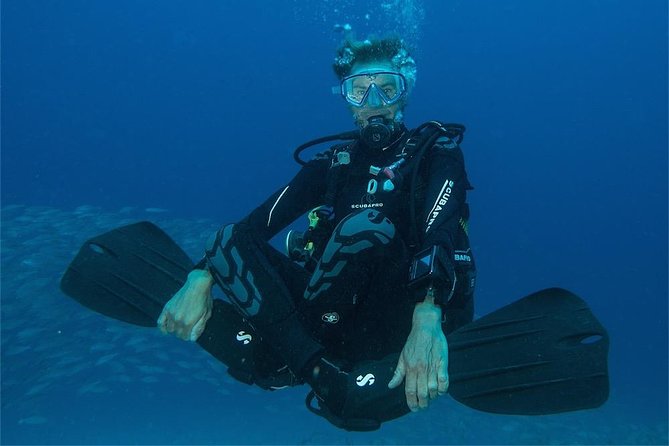
The course lasts about three days, although the exact timetable is planned with you. That is helpful when scuba training is part of a larger Tenerife holiday. You can discuss the schedule with the centre rather than simply accepting a fixed plan.
You complete five adventure sessions. Two are required:
- Navigation
- A descent to 30 metres
You then choose three additional options from:
- Night session
- Wreck session
- Peak Performance Buoyancy
This structure gives you a little control over the course. Someone interested in underwater photography may value buoyancy work most. Someone who wants more confidence in unfamiliar locations may prefer navigation and a night session. A wreck enthusiast will naturally want the wreck option, although the information provided does not identify a particular wreck site.
The 30-metre session is the centrepiece for many people. Greater depth changes the task. You have less time available, and small problems with air use, buoyancy, or awareness matter more. The instructor’s job is not to rush you down. It is to help you understand how to plan and behave responsibly at that depth.
Navigation is just as useful, even if it sounds less exciting. Losing your sense of direction is one of the easiest ways to turn a relaxed underwater outing into a tiring one. Learning to use headings and natural references gives you a skill you can carry to future locations.
The remaining three sessions make the course more personal. A night session offers a different setting and demands closer attention to your equipment and communication. A wreck session adds an element of exploration, while buoyancy training helps you move with less effort and avoid unwanted contact with the bottom. The exact order depends on planning, availability, and conditions.
What each specialty adds
Navigation for more independent scuba sessions
Navigation is the practical backbone of the course. You learn to maintain direction, follow a plan, and improve your awareness of where you are. This is useful on almost every future outing, especially when you are visiting a new centre or unfamiliar site.
I would treat this session as more than a box to tick. If you have ever surfaced unsure of where you started, you already know why it matters. Good navigation can make a short session feel more relaxed because you spend less time wondering where you are.
More dive courses in Tenerife:
- Try Dive – PADI Discover Scuba Diving in Tenerife
★ 5.0 · 214 reviews - PADI Open Water Diver Course (OWD) – 2.5 days
★ 5.0 · 98 reviews - PADI Discover Scuba Diving Course in Tenerife
★ 4.8 · 64 reviews - Basic Diver course for beginners with 1 dive in the Ocean
★ 5.0 · 41 reviews
The 30-metre session for greater depth
The required deep session takes you up to 30 metres. That is the advertised limit of the qualification, not an invitation to treat the number casually. You still need to follow your training, plan carefully, and stay within the limits set by your certification and instructor.
This session is best approached as a lesson in depth management, not as a race to reach a number. Your instructor can help you understand how depth affects your plan and comfort. If you feel uncertain, the small group gives you a better chance to speak up and adjust the pace.
Night training for a new kind of awareness
The night option changes the way you use your attention. You rely more closely on your light, your guide, and your communication. Familiar skills can feel new when visibility and orientation work differently.
The listing does not promise a particular site or wildlife encounter, so you should not book this expecting a guaranteed spectacle. Book it for the skill and the change of atmosphere. Ask the centre how the session will fit into the three-day schedule.
Wreck training for structure and exploration
A wreck session adds a clear point of interest to the course. It can also test your buoyancy and awareness around a large fixed object. The available information does not specify the wreck, penetration rules, or equipment arrangements, so ask for those details before choosing this specialty.
That missing detail is not necessarily a problem. Wreck conditions can affect the plan, and the centre may decide what is suitable based on weather, conditions, and your experience. You should simply avoid assuming that every wreck session includes entering the wreck.
Peak Performance Buoyancy for better control
Buoyancy work is the quiet achiever of the five options. It helps you use less effort, move more smoothly, and maintain better control of your position. It can also make navigation and photography easier because you are not constantly adjusting your depth.
This may be the best choice if you feel busy underwater. A small change in breathing and body position can improve the whole experience. You may not leave with the most dramatic story, but you can leave with a skill that improves nearly every future session.
How the small group changes the experience
Two people maximum per course is a major selling point. In a larger class, an instructor must divide attention among several participants with different abilities. Here, you have a much better chance of receiving immediate feedback.
That does not mean the course is effortless. You still need to prepare, listen, and practice. A small group gives you more teaching time, but it also makes your own progress more visible. If you arrive tired, anxious, or out of practice, tell the instructor early.
The centre’s stated approach is relaxed but rigorous. That is the right balance for a qualification course. You should feel comfortable asking basic questions, but you should also expect the instructor to hold you to safety standards. Friendly instruction is valuable only when it does not soften important rules.
Previous course participants have returned to the centre years after their first certification, and some have come back for further training. That makes sense for a small operation where the relationship with the instructor is part of the experience. Ludo and Julie are described as welcoming and flexible, while the equipment is reported as clean and masks and regulators disinfected. Those are useful signs for anyone who cares about preparation and hygiene.
Theory, e-learning, and preparation
Most course options are available with e-learning for the theory section. If your booking includes that route, completing the academic work before your holiday should leave more time for practical training in Tenerife.
You should confirm exactly how the theory is handled when you book. The centre can also provide the support material needed if e-learning is not used. Do not assume that finishing online work means you can skip instructor briefings. Practical plans, safety procedures, and session details still need to be covered.
The course requires a moderate level of physical fitness. You should be comfortable handling the demands of scuba equipment and following instructions over several sessions. The supplied information does not list medical requirements, equipment inclusions, water temperatures, or transport arrangements, so ask about those points before paying.
Meeting in Las Galletas
The meeting point is LJ Diving Tenerife, at Calle Consuelo Alfonso Diaz-Flores, 16, 38631 Las Galletas, Santa Cruz de Tenerife. The activity ends back at the same meeting point.
Las Galletas is in southern Tenerife, and the centre is near public transportation. That makes it easier to reach if you are staying nearby or using local transport, though no pickup service is listed. Plan to make your own way to the centre unless the operator confirms another arrangement.
Opening hours are listed as 9:00 a.m. to 6:00 p.m., Monday through Sunday. The course itself lasts about three days, but your exact start times need to be arranged with the centre. Confirmation is sent within 48 hours of booking, subject to availability.
The mobile ticket is convenient, but it does not replace careful planning. Keep the booking details accessible on your phone and check that the dates, meeting point, and course plan match what you discussed with the centre.
Is $596.12 a fair price?
At $596.12 per person, this is not a casual add-on. You are paying for a three-day qualification course, five adventure sessions, an instructor-led training plan, and a very small group. If you value personal attention and want a recognized PADI qualification, the price can make sense.
The price is harder to judge if you are mainly seeking a few recreational outings. This is a training programme, not a sightseeing package. You should also confirm what the fee includes, since the supplied details do not spell out equipment rental, certification charges, course materials, or any other extras.
For me, the strongest value comes from the two-person limit and the flexible plan. A cheaper class with a large group may offer less time for questions and corrections. A private or near-private course can be worth paying more for if you want to build confidence properly.
The no-refund policy makes the decision more serious. You cannot cancel or amend the booking for a refund. If bad weather causes the operator to cancel, you are offered another date or a full refund. Before booking, make sure your holiday dates are firm and ask what happens if your own plans change.
Who should book this course?
You are a good match if you already have at least 10 logged scuba sessions and want to improve your skills rather than simply collect another activity. The course suits people who want to reach 30 metres under instruction, gain better navigation, or add a night, wreck, or buoyancy specialty.
It is also a good choice if you prefer direct contact with your instructor. The two-person limit is especially useful if you are returning to scuba after time away, have a specific skill concern, or learn better when you can ask frequent questions.
It may not suit you if you have fewer than 10 logged sessions, want a one-hour introduction, or need a fully refundable booking. You should also think carefully if you are looking for a large social group. This course is built around focused instruction, not a party atmosphere.
Should you book the Advanced Open Water course?
Book it if you want a serious but friendly route to the PADI Advanced Open Water Diver qualification, and if you value a maximum class size of two. The five-session format gives you a useful spread of skills, while the flexible choices let you shape the course around your goals.
The best reason to choose LJ Diving Tenerife is the personal approach associated with Ludo, Julie, and their team. The strongest practical reason is the chance to work closely with an instructor over roughly three days. Just confirm what the $596.12 fee includes, make sure you meet the 10-session requirement, and accept the strict cancellation terms before committing.
FAQ
Where does the course begin?
You meet at LJ Diving Tenerife, Calle Consuelo Alfonso Diaz-Flores, 16, 38631 Las Galletas, Santa Cruz de Tenerife, Spain.
Where does the activity finish?
The activity ends back at the meeting point in Las Galletas.
How long does the certification course take?
The course lasts approximately three days. The schedule is planned with you.
How many logged scuba sessions do I need?
You need a minimum of 10 logged scuba sessions before taking the course.
How many people can join each course?
The course is private, with a maximum of two participants.
What sessions are included?
You complete five adventure sessions. Navigation and the 30-metre session are mandatory. The other choices are night, wreck, and Peak Performance Buoyancy.
Is e-learning available for the theory?
Most course options have an e-learning possibility for the theory. If that is not used, the centre provides the necessary support material.
What happens if poor weather cancels the course?
If the operator cancels because of poor weather, you can choose a different date or receive a full refund. The experience is otherwise non-refundable and cannot be changed for any reason.
Just added around Tenerife
- Tenerife: 2 Diving Sessions for Certified Divers★ 4.2 · 7 reviews
- Beginner Scuba Dive with Scubapoint Tenerife in Turtle Area★ 4.7 · 8 reviews
- Scuba Experience in Tenerife with Guide★ 5.0 · 30 reviews
- Try Scuba Diving in a turtle area (boat)★ 5.0 · 93 reviews
- Try Dive in Abades Bay with a private instructor★ 4.0 · 4 reviews
- Try Scuba Diving Puerto Colon★ 5.0 · 2 reviews
- First Dive Experience in Tenerife★ 4.5 · 69 reviews
- Scuba Night Dive on Tenerife★ 5.0 · 6 reviews
Scuba Diving Courses, compared.
Open Water Course – Become certified diver in 3 days
Read our review →
Heraklion: Beginner Scuba Diving Lesson with PADI Instructor
Read our review →
Discover Scuba Diving with No Certification in St Thomas
Read our review →
Try Dive – PADI Discover Scuba Diving in Tenerife
Read our review →
Lists this dive appears in