
REVIEW · ITALY
Double Dive in the Bay Park for certified divers
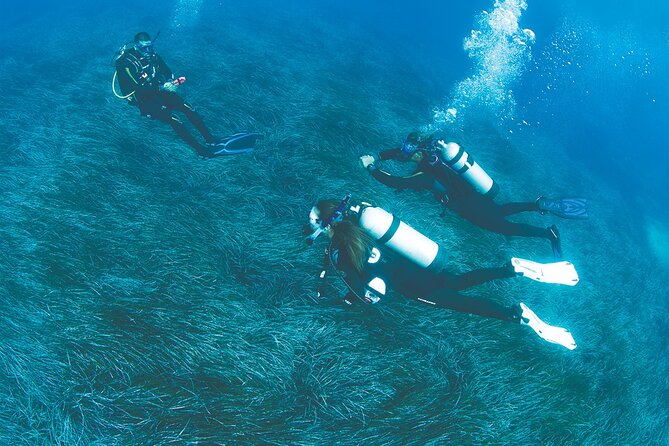
Baia’s ancient Roman villas lie beneath the water, and this outing gives you two chances to see them rather than rushing through one short underwater visit. You’ll explore foundations and mosaics in water no deeper than about 5 meters, with each session lasting roughly 45 minutes.
I like the small maximum group of five, which should make the briefing and underwater supervision more personal. I also like the tidy setup: equipment, park admission, boat transport, insurance, showers, and changing rooms are all included.
The main catch is that this is an archaeological site, not a wildlife outing. You may see some sea life, but the real attraction is the Roman remains, and visibility can suffer when sand is moved to uncover and protect the mosaics.
Key points to know before booking
- Two 45-minute underwater sessions: You get enough time to inspect the site without treating it as a quick photo stop.
- Very shallow archaeological sites: The greatest depth is about 5 meters, so air supply is less of a concern than comfort and visibility.
- Small group of five: The size suits certified beginners and anyone who wants close guidance.
- Alessandro leads the briefing: Expect an introduction to Baia’s sunken city and the specific sites planned for the day.
- RIB ride under five minutes: The boat leaves from near the center, keeping the outing compact and efficient.
- January water was 17°C: A 5 mm wetsuit and boots were supplied, and 5 mm gloves helped keep hands warm in winter.
Why Baia is such an unusual place to go underwater
Baia was once a Roman resort town on the Bay of Naples. Parts of its villas and public buildings now sit below the sea, the result of gradual ground movement in the volcanic Campi Flegrei area.
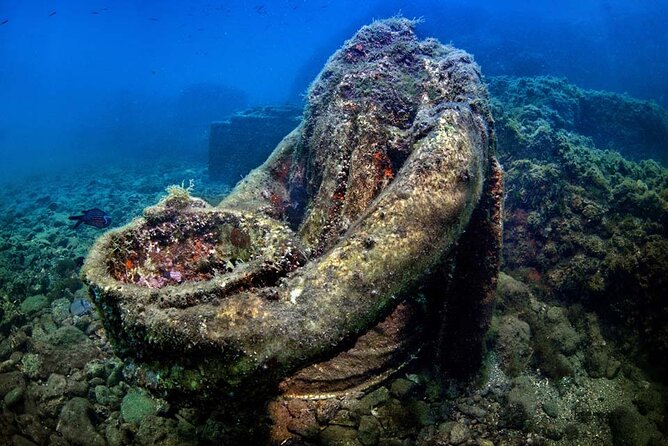
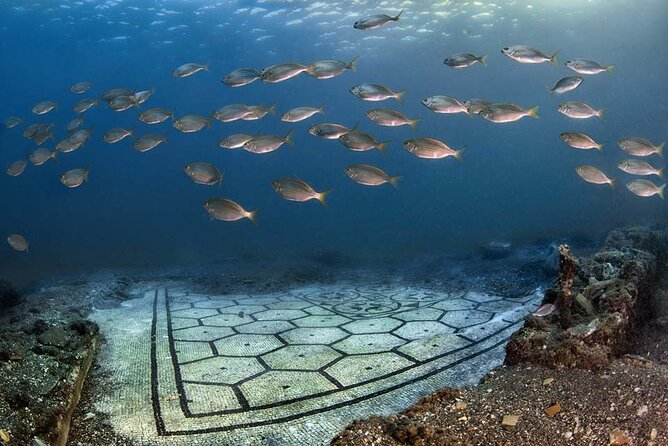
You are not visiting a typical reef or wreck site. The underwater setting is an archaeological park, and the focus is on walls, pavements, foundations, and mosaics that once belonged to wealthy Roman residences and baths.
That gives this outing a different rhythm. You will spend more time looking carefully at low remains on the seabed than searching for schools of fish. The shallow depth makes the site approachable, but it also means sunlight, sand, boat traffic, and other groups can affect visibility.
I like that the two-session format fits the place. One underwater visit can feel too brief when you are trying to understand a mosaic or work out the shape of a buried structure. The second session gives you another site and a chance to settle into the unusual task of reading ruins underwater.
More dives for certified divers in Italy:
- Diving for certified divers with PADI 5* Diving Resort – Taormina
★ 5.0 · 167 reviews - Scuba Diving in La Maddalena & Lavezzi Park for certified divers.
★ 5.0 · 20 reviews - Diving at the Baia Submerged Park for certified divers
★ 5.0 · 11 reviews
Arriving at the center and preparing your equipment
Plan to reach the meeting point at Via Lucullo in Baia about one hour before the scheduled start. That early arrival is useful, not wasted time. You need to receive equipment, change, attend the safety briefing, and hear how the archaeological sites are being handled.
The center supplies the scuba equipment, and showers and changing rooms are available after the activity. Insurance, taxes, and the entrance ticket to the Archaeological Park are also included, so the price is easier to judge than it might first appear.
Alessandro provides the briefing and introduces the sunken city before you leave shore. You will also hear about the particular locations planned for your two sessions. That matters here because you are not simply following a guide along a natural wall. You need some context to recognize what you are seeing below the surface.
The group limit is five people. That is a useful size for an archaeological site, where you may need to pause, keep your position, and listen for instructions before moving on. It should also reduce the feeling of being part of a large recreational group.
The minimum qualification is Junior Open Water Diver or Scuba Diver. You need to bring proof of certification if requested by the operator. If you are not certified, this is not the right booking. The operator instead points non-divers toward a surface snorkeling visit or a Discover Scuba Diving program.
The short RIB ride to Baia’s Underwater Park
The boat launch is only a few steps from the center. The RIB reaches the submerged park in less than five minutes, which keeps the outing focused on the water rather than on a long transfer.
That short ride is one of the practical strengths of the trip. You are not spending a large share of a four-hour activity crossing the bay. After the briefing and equipment setup, you move quickly from the shore to the archaeological area.
The day includes two underwater sessions, each planned for approximately 45 minutes. The schedule allows about an hour at each buoy, leaving room for entering the water, descending, exploring, and returning to the boat without forcing the session to run at full speed.
The two visits may be adjusted around other groups using the site. Alessandro has already shown that he can change the timing on the boat when another group is working nearby. That flexibility is helpful because this is a protected archaeological area, not a private site controlled by one boat.
Tempio di Venere and the Roman remains
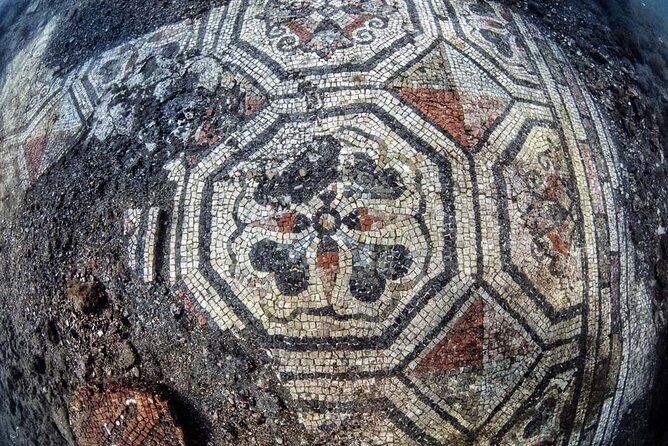
Tempio di Venere, or the Temple of Venus, is listed as the first stop. The underwater appeal here is the chance to connect the name of an ancient Roman structure with the fragments and foundations preserved below the water.
Do not expect a complete temple rising from the seabed. At this depth, the experience is about interpreting remains. You may be looking at the footprint of a building, sections of masonry, or paving rather than a dramatic intact monument.
This is where the briefing earns its keep. Without an explanation, low walls and scattered stones can be hard to read. With context, the seabed becomes a plan of an old Roman property, even when the water and sand obscure parts of it.
Visibility is not guaranteed to be crystal clear. Sand is moved as mosaics are uncovered and then protected again, and that work can cloud the water. You should treat this as a cultural site where conservation comes first.
A few more dives around Italy worth comparing
- Polignano a Mare boat tour emotions, caves, diving and appetizers
★ 5.0 · 1,022 reviews - Catania: Gulf Scuba Diving Tour with Marine Biologist
★ 4.9 · 212 reviews - Diving for patented divers
★ 5.0 · 175 reviews - TuffAlcantara – dives, slides and lots of fun in the Alcantara river
★ 5.0 · 106 reviews
Baiae and the thermal complex
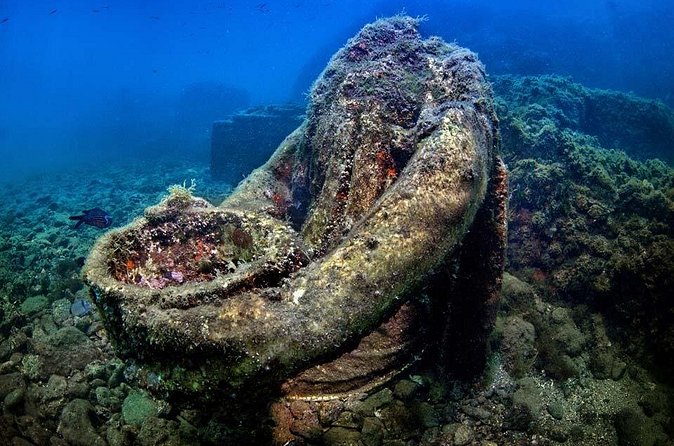
Baiae, also written Baiae or Baia, was known in Roman times for its villas and baths. The itinerary also includes the Parco Archeologico delle Terme di Baia, the archaeological park of Baia’s thermal baths.
These names help place the underwater remains within a larger story. You are not seeing isolated stones with no connection. The submerged structures belong to a former settlement whose villas and bath buildings spread through the Baia area.
The thermal complex is especially useful context for understanding why the site has so many foundations and paved areas. The attraction is not a single monument. It is the pattern of Roman building, public life, and private luxury revealed by the remains.
Again, keep your expectations sensible. The information provided does not promise a particular mosaic, room, statue, or marine animal on every outing. Conditions and the exact plan can vary, so the value comes from the setting, the guide’s explanation, and the chance to see the underwater archaeology firsthand.
Castello Aragonese and the wider bay
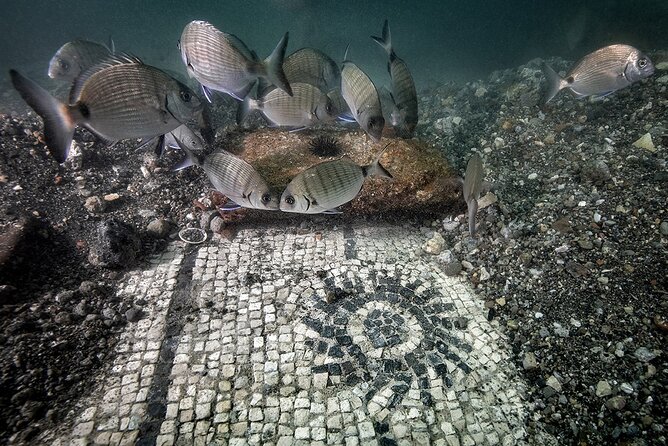
Castello Aragonese di Baia Napoli appears among the places included in the route. The castle is part of the visible setting around the bay and helps you understand the long history of this small coastal area, from Roman occupation to later fortification.
You may not spend a separate underwater session at every location named in the route. The two actual underwater visits are the core of the activity, while these landmarks provide geographic and historical context for the Baia area.
Rione Terra and Pozzuoli are also listed. Rione Terra is the historic elevated district of Pozzuoli, while Pozzuoli itself is the nearby town and port area. Their inclusion gives you a wider sense of the local setting, although the supplied schedule does not promise a walking visit or a dedicated stop on land.
The same applies to Monte Nuovo and Campi Flegrei. Monte Nuovo is the volcanic feature near Pozzuoli, and Campi Flegrei is the broader volcanic area surrounding Baia. These names explain why the region has unusual ground movement and why some ancient structures now sit underwater.
Vesuvius National Park and the regional setting
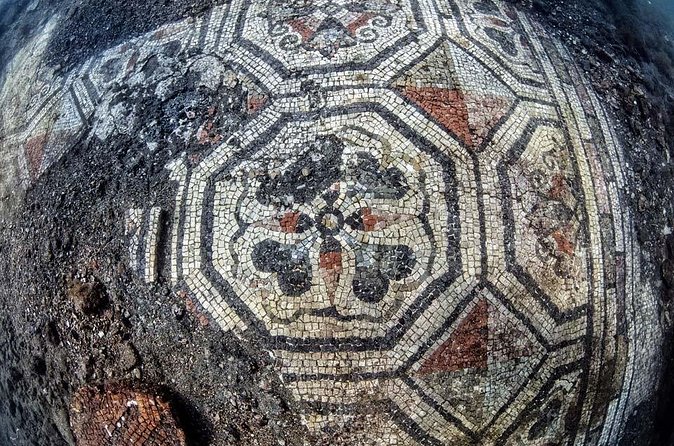
Vesuvius National Park is also named in the route information. It is not presented as a separate excursion from the boat or as a hike during this four-hour activity.
Instead, think of it as part of the Naples area context. The region is shaped by volcanoes, and the Roman remains around Baia make more sense when you recognize that the ground itself has changed over time.
This is a useful reminder to keep your expectations focused. You are booking an underwater archaeological outing in Baia, not a combined visit to Vesuvius, Pozzuoli, Rione Terra, and the castle. The route names show the wider area connected with the park, but the schedule is built around two underwater sessions.
What the 5-meter depth means for you
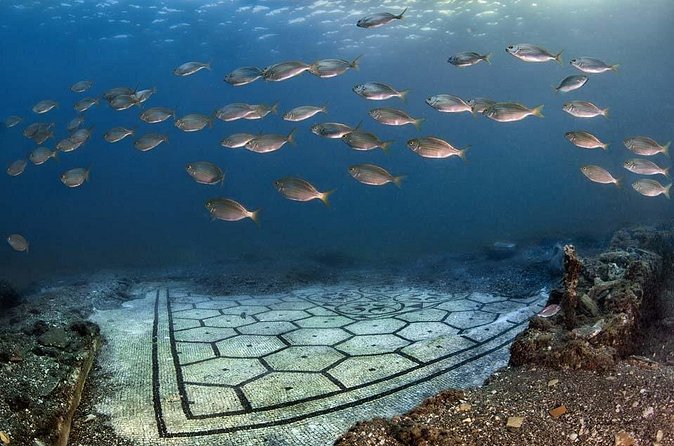
The maximum depth reported for the site is about 5 meters. That is shallow by scuba standards, and it means you are unlikely to use your air quickly simply because of depth.
The shallow water can make the outing less demanding for certified newcomers, particularly when paired with a small group and a clear briefing. It can also help you spend time examining the remains instead of concentrating on a long descent or ascent.
There are trade-offs. Shallow water can be more affected by wave movement, sunlight, and disturbed sand. At a site where mosaics are periodically uncovered and recovered, the water may not always be clear.
The January conditions provide a useful winter guide. The water was 17°C, and the supplied 5 mm wetsuit and boots were considered suitable. If you go in winter, 3 mm or 5 mm gloves are a sensible addition. A 5 mm pair kept one participant’s hands warm in January, but your comfort will depend on your own cold tolerance.
No water temperature is supplied for summer, so I would not promise a particular wetsuit choice outside winter. Ask the center about current conditions if thermal comfort matters to you.
Marine life, mosaics, and what you will actually see
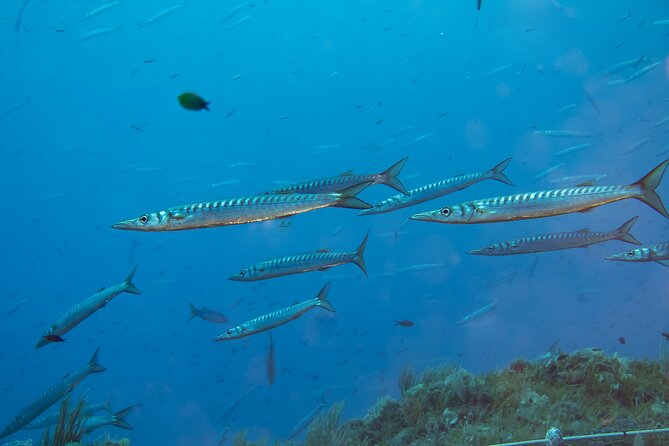
You may see some sea life, but marine animals are not the reason to choose this outing. The site’s appeal is archaeological, and the former villa foundations and mosaics are the main reward.
That distinction is important when comparing this with a natural reef trip. If you want colorful coral, large fish, or a strong wildlife focus, Baia may feel restrained. If you like Roman history and the odd sensation of swimming over a former town, the shallow ruins offer something far more unusual.
Mosaics can be affected by conservation work. Sand is used to cover and uncover them, which helps protect the archaeological material but can reduce visibility. You may need patience and a good eye rather than expecting a perfectly clear, cinematic view.
The best approach is to listen to the guide, move slowly, and let the site reveal itself. A small section of pavement can be more meaningful than a grand structure when you understand that it belonged to a Roman villa now resting under the sea.
What is included for $144.19
At $144.19 per person, the price is reasonable if you value a guided archaeological experience rather than simply boat transport and tank time.
Your fee includes scuba equipment, the RIB ride, the Archaeological Park admission ticket, insurance, the guide, showers, changing rooms, taxes, and other fees. Adding those costs separately would make a simple comparison misleading.
The four-hour duration is also accurate. The schedule includes arriving about an hour before the start, preparing, traveling to the site, completing two sessions, and returning to the center. A previous January outing ran for the advertised four hours, so you should plan around that full block of time.
Lunch is not included. You can request a meal at a partner restaurant for 35 euros, with 10 appetizers, a first course, a second course chosen from the menu, dessert, water, and wine. That is an optional add-on, not part of the basic booking.
Who should book this experience
I would choose this for a certified scuba user who likes archaeology, shallow water, and a small group. It is especially suitable if you want an unusual Naples activity away from the usual street-level sights.
The trip also makes sense for a newer certified participant who wants an interesting site without great depth. The Junior Open Water Diver or Scuba Diver minimum qualification keeps the requirement clear, while the shallow water and 45-minute sessions make the plan less intimidating than a deep offshore outing.
You should think twice if your main goal is marine wildlife or guaranteed clear water. Conditions can be cloudy, and the archaeological work that protects the mosaics can affect what you see.
The four-hour schedule suits a day when you want a single focused activity. It may be less convenient if you are trying to squeeze several major Naples sights into the same morning or afternoon.
The experience is offered in English, and mobile tickets are accepted. It is near public transportation, service animals are allowed, and most people who meet the certification requirement can participate. The weather needs to cooperate. If poor weather cancels the outing, you can choose another date or receive a full refund.
Should you book the Baia scuba outing?
Book it if the idea of examining Roman villas and mosaics beneath the sea excites you more than seeing a long list of fish. The combination of two 45-minute sessions, a five-person maximum, shallow remains, and included equipment gives you solid value for the price.
I would add warm gloves for a winter booking and ask about current water conditions before you go. I would also leave room in your expectations for clouded water and partially preserved ruins.
For a certified scuba user visiting Naples, this is a distinctive choice. It connects the Roman past with the volcanic character of the Bay of Naples, and it gives you enough underwater time to understand the site rather than simply touch it and leave.
FAQ
How long does the experience last?
The activity lasts approximately four hours, including preparation, the boat ride, two underwater sessions, and the return to the center.
How long is each underwater session?
Each session lasts approximately 45 minutes. The schedule allows about one hour at the buoy of each site.
What certification do I need?
You need at least a Junior Open Water Diver or Scuba Diver certification.
How deep are the sites?
The greatest depth is about 5 meters.
Is equipment included?
Yes. Scuba equipment, RIB transport, the archaeological park ticket, insurance, guide service, showers, changing rooms, taxes, and fees are included.
Is lunch included?
No. Lunch can be arranged on request at a partner restaurant for 35 euros per person. The meal includes appetizers, a first course, a second course, dessert, water, and wine.
What happens if bad weather cancels the outing?
If poor weather causes cancellation, you can select another date or receive a full refund. You can also cancel for a full refund if you do so at least 24 hours before the start time.
Just added around Italy
- Villasimius: Capo Carbonara First Time Dive with Instructor★ 4.9 · 50 reviews
- Villasimius: Scuba Dive in Capo Carbona without Certificate★ 4.9 · 23 reviews
- Scuba diving in Calabria, Italy★ 5.0 · 23 reviews
- Discover Scuba diving in Calabria, Italy★ 4.5 · 3 reviews
- Double dive in the Punta Campanella Marine Protected Area★ 5.0 · 11 reviews
- Guided diving for beginners without certification from Sorrento★ 5.0 · 22 reviews
- Discover Scuba Diving PADI – Trial dive in Sorrento★ 5.0 · 2 reviews
- Try Scuba Dive (baptism of the sea)★ 5.0 · 5 reviews
Dives for Certified Divers, compared.
Open Water Course – Become certified diver in 3 days
Read our review →
Two-Tank Morning Dive Trip for Certified Divers
Read our review →
2 Tank Lanai Cathedral Scuba Dive Via Boat for Certified Divers
Read our review →
Wreck and Bridge Span Dive for Certified Divers
Read our review →
Diving for Certified Divers, 2 Tanks Sosúa Bay
Read our review →
Certified Diver: 2-Tank Deep Wreck and Shallow Reef Dive Off Oahu
Read our review →
Certified Diver: 2-Tank Shallow Reef Dives off Oahu
Read our review →
2 Dives in the morning for certified divers in Bora Bora
Read our review →Lists this dive appears in