REVIEW · SCUBA DIVING
Private Walking Tour of Delft: Dive into the Dutch Golden Age
Delft’s story comes together in a surprisingly compact walk. In two hours, you trace royal burials, a leaning church tower, William of Orange’s assassination site, old canals, Dutch East India Company connections, and the exact spot linked to Vermeer’s View of Delft. It is a fine way to see why this small city mattered so much.
I like the private format, since your group can ask questions and adjust the pace. I also like the easy center-city start at the Hugo Grotius statue, plus the option for pickup anywhere in Delft’s city center. The main consideration is that this is a fast-moving overview, with about 15 minutes allotted to each of eight stops, and the tour is described as a walking visit rather than a museum-entry experience.
Key points to know before booking

- The walk links Delft’s biggest stories: royal history, religion, water control, trade, warfare, and art all appear within a short route.
- You get a private guide for up to 15 people: Robin and Matyas are among the guides named for this experience.
- The meeting point is central: Begin and end beside the Hugo Grotius statue on Delft’s Markt.
- The Old Church and Prinsenhof carry real historical weight: You’ll hear about Vermeer’s grave and William of Orange’s assassination.
- The route is useful for first-time visitors: It gives you a clear map of Delft before you choose where to spend more time.
- Pickup is available in Delft’s city center: This can help if you want to avoid finding the starting point on your own.
Delft in two hours, from royal church to café square

This is not just a stroll past pretty canals. The route explains how Delft became tied to the Dutch royal family, why its water board mattered, how the city earned a place in the Dutch Republic’s military and commercial story, and why Vermeer’s name still hangs over the streets.
You begin and end at the same spot, the Hugo Grotius statue on Markt. That simple arrangement works well. You do not need to plan a second meeting point, and you can ask your guide for a restaurant or beer recommendation at the end without having to cross town.
The pace is brisk. The tour gives roughly 15 minutes to each listed stop, though much of that time includes walking between places. If you want to enter several buildings, study museum displays, or linger over church interiors, two hours will not be enough. If you want the city’s main stories and a strong sense of direction, the timing makes sense.
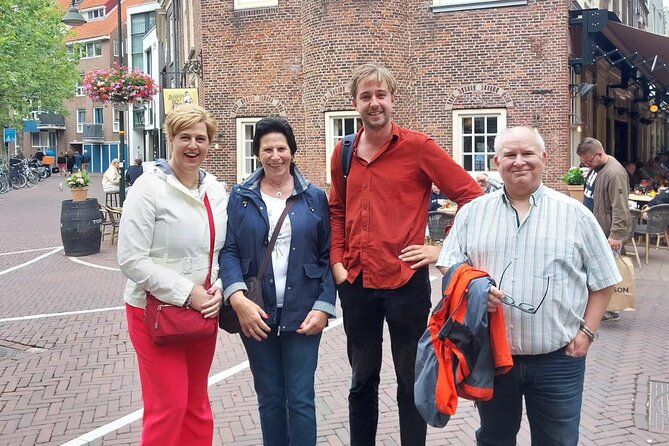
The tour is private, so you do not share the guide with strangers. That matters most for families, mixed-age groups, or anyone who likes to stop for questions. One guide, Robin, is described as easygoing and adaptable, and a group that included a senior citizen and a small child was able to adjust the route when needed. That flexibility is a practical advantage, not just a pleasant extra.
A few more dives around the world worth comparing
- Delft: Dive into the Golden Age on a Private Walking Tour
★ 4.6 · 16 reviews - Dive into Tsukiji Fish Market Walking Friendly Food Tour
★ 5.0 · 3 reviews
Starting on Markt beside the New Church
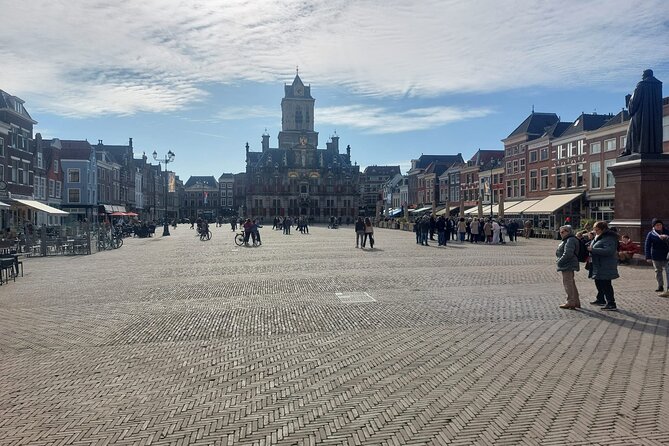
The walk opens on Delft’s Markt, one of the oldest market squares in the Netherlands. Your guide meets you beside the Hugo Grotius statue, then uses the New Church to set the scene.
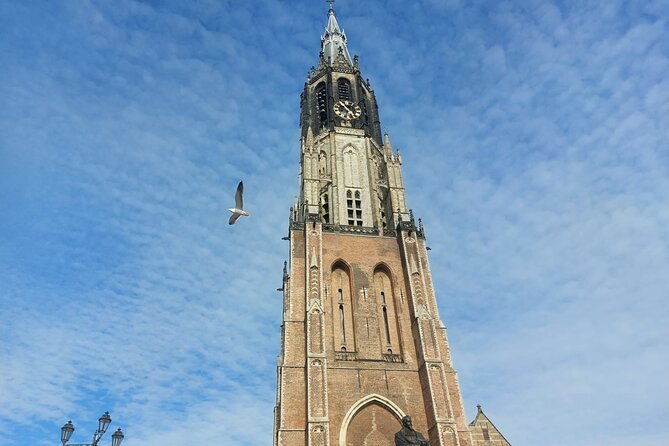
The New Church is the burial place of the Dutch royal family and of Hugo Grotius, the Delft-born legal thinker whose statue marks your meeting point. Its tower is the second tallest church tower in the Netherlands, giving the square a strong visual anchor.
You may not spend much time inside. The stop is listed with no admission charge, and the tour description focuses on explanation and historical context rather than a formal church visit. That is useful to know if you hoped to climb the tower or explore the interior at length. The benefit is that you get the story first, then can decide later if you want to return.
This opening also helps you understand Delft’s connection with the House of Orange. The city is not only a place of canals and blue-and-white pottery. It played a major role in the formation of the Dutch state, and the New Church is one of the clearest reminders.
Delft Town Hall and the city’s hard edge
Leaving Markt, the guide passes Delft’s historic Town Hall. Its elegant Renaissance façade can look calm and orderly, but the building’s past was far less gentle.
Behind the façade are stories of city government, fires, justice, and imprisonment. The Town Hall once included a prison, a detail that gives the polished square a little more bite. This is one of those quick stops where a guide adds value. Without context, you might admire the architecture and keep walking. With context, you begin to see the square as the center of power, law, and public life.
The tour does not promise an interior visit, so consider this a street-level introduction. That suits the overall design. You are moving through Delft’s urban story rather than stopping for a full architectural inspection at every building.
The Old Church, Vermeer, and the leaning tower
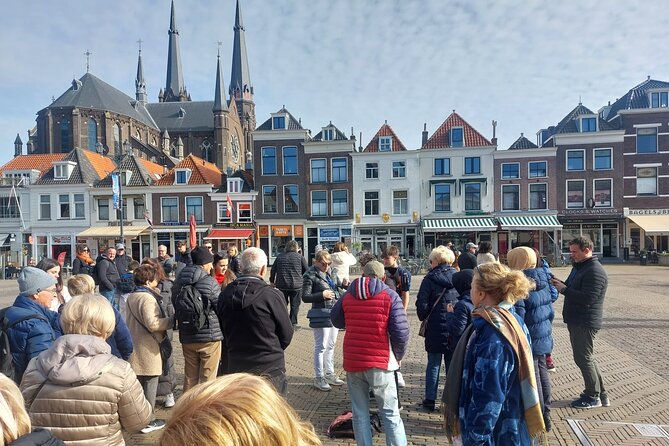
The route continues past the former Butter House, the old Weigh House, and the historic home of Antonie van Leeuwenhoek. These smaller details are important because they show how Delft functioned as a working city. Weighing goods, brewing beer, trading food, and producing scientific knowledge were all part of daily life.
You then enter the former beer-brewing quarter and reach the Old Church, one of Delft’s most recognizable sights. Its tower leans noticeably, and your guide explains why the trouble began almost as soon as construction started.
The building’s nickname and angle may attract the eye, but the interior has another major connection: Johannes Vermeer is buried here. Vermeer painted only a small number of known works, yet Delft is inseparable from his name. This stop gives you a direct link between the artist and the city where he lived and worked.
The tour also takes you near the exact location where Vermeer stood while painting View of Delft. That detail is especially valuable for anyone interested in art. You are not just hearing about an old painting in a museum. You are connecting the image to an actual Delft viewpoint.
Again, the timing is short. You may want to return later if you wish to spend quiet time inside the Old Church. For a first look, the guide’s explanation makes the building memorable.
More private dive charters in the world:
- Private Discovery Dive + Photos & Videos
★ 5.0 · 577 reviews - Private Diving at Zenobia Wreck in Larnaka
★ 5.0 · 369 reviews - Full-Day Beginner Scuba Course with Private Tuition, Racha Yai
★ 5.0 · 368 reviews - Full day diving with private guide, lunch drinks transportation
★ 5.0 · 285 reviews
Prinsenhof and the death of William of Orange
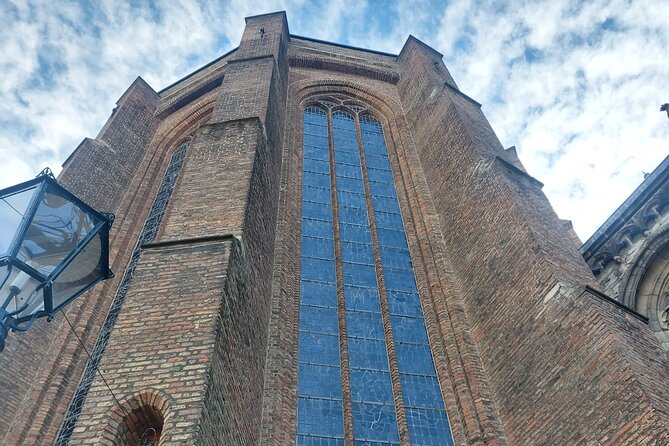
Opposite the Old Church is the Prinsenhof, a former monastery that later became the residence of William of Orange. He is often called the Father of the Fatherland because of his role in the Dutch revolt against Spanish rule.
The Prinsenhof is also where William of Orange was assassinated in 1584. The event had major consequences for the future of the Netherlands, and the guide explains how it strengthened Delft’s link with the House of Orange.
This is probably the most politically charged stop on the walk. The story gives Delft a sharper place in national history. You begin to understand why the city is connected not only with art and canals but also with the creation of an independent Dutch state.
The building now houses Museum Prinsenhof Delft, but this experience does not list museum admission as part of the tour. If you want to see the museum, plan a separate visit. The walking tour gives you the setting and the essential story, while a museum visit would let you spend more time with the objects and displays inside.
Along Oude Delft, where water shaped daily life
Walking along the Oude Delft canal, you see the oldest surviving house in Delft. Since 1645, the richly decorated building has housed the local Water Board.
A water board may sound less exciting than a royal church or an artist’s grave, but it is one of the most useful parts of the tour. The Netherlands has always depended on organized water management, and a city’s safety and prosperity could depend on keeping water in the right place.
Your guide explains what the Water Board does and why its work was a matter of survival. That context changes how you look at Delft’s canals. They are not merely scenic ribbons beside attractive houses. They are part of a system that allowed people to live, work, trade, and build in a country shaped by water.
This is also a good stretch for people who enjoy everyday history. The focus shifts away from famous names and grand events toward the practical systems that kept the city functioning.
Armamentarium and Delft’s Golden Age connections
Farther south along Oude Delft, the route passes historic residences and reaches the former state weapons armory, known as the Armamentarium. Nearby is the main building of Delft’s chamber of the Dutch East India Company.
These sites show Delft’s role in the Dutch Republic’s military, maritime, and commercial expansion. The city was not an isolated artistic town. It had a place in the machinery of trade, defense, and overseas activity that helped define the Dutch Golden Age.
The stop is valuable because it broadens the tour’s scope. You have already seen churches, royal connections, and water management. Here, you get the economic and military side of Delft.
The route does not claim to include a weapons collection or a full East India Company museum visit. Instead, your guide points out the buildings and explains what happened there. That makes the tour a good orientation for a longer Delft visit, but less suitable if you want extended time inside historic collections.
The former synagogue and Delft’s Jewish history
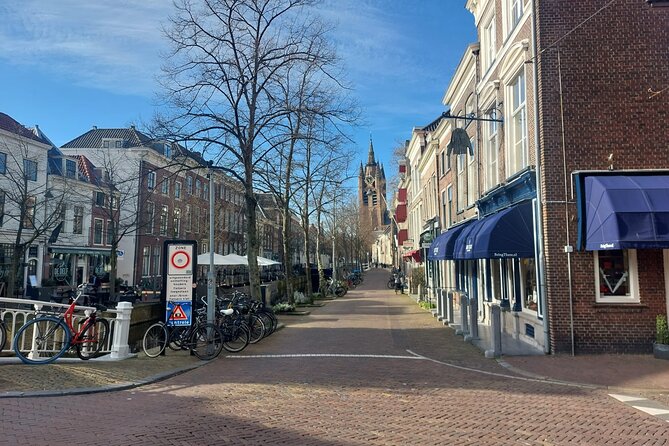
Walking north along Delft’s second-oldest canal, once used as the city’s grain market, you pass the former synagogue.
This stop introduces the long presence of Delft’s Jewish community. It is a quieter part of the route, but it keeps the city’s story from becoming too narrow. Delft was shaped by more than royalty, painters, merchants, and officials.
The canal itself adds useful context. Its earlier role as a grain market reminds you that these waterways were working spaces. Delft’s prettiest streets often carried food, goods, and people as well as reflections of old houses.
The synagogue is passed from the outside, so think of this as a brief historical marker. If this aspect of Delft interests you, ask your guide questions while you are there. A private format gives you room to steer the conversation toward the subjects you care about most.
Finishing at Beestenmarkt with local advice
The walk ends at Beestenmarkt, a former animal market just behind Markt. Today, the square is lined with cafés and restaurants and is one of Delft’s popular gathering places.
This is a smart ending. You finish near the starting point, close to places where you can sit down, have a beer, grab a casual snack, or arrange dinner. Your guide can offer local suggestions, which is particularly helpful after a short first visit when you may not yet know which streets are best for an evening meal.
I also like the way the end point keeps the tour practical. You are not simply dropped beside an anonymous street. You finish in a social square where you can continue exploring at your own pace.
What the private price means for your group
The listed price is $203.22 per group of up to 15 people. For one or two people, that is a fairly serious outlay for a two-hour walk. For a larger family or group of friends, the cost becomes more attractive because it is shared rather than charged per person.
The private format is the main reason to consider the price. You get an English-speaking guide dedicated to your group, and you can ask questions without competing for attention. The value is strongest if you have a particular interest in Delft, need a flexible pace, or want a short introduction before exploring on your own.
All fees and taxes are included. The tour description lists the stops with no admission charge, but it does not include separate entry to the New Church, Old Church, Prinsenhof, or other interiors. Treat the experience as a guided city walk with exterior visits and historical explanation.
The tour is booked, on average, 51 days in advance. That suggests planning ahead is sensible, especially if your Delft visit falls on a busy date. Confirmation is normally provided at booking, though bookings made within one day of the tour are confirmed as soon as possible and depend on availability.
Who will get the most from this Delft walk
I would choose this tour if you are visiting Delft for the first time and want the main story without spending a full day on a formal sightseeing program. It also suits people who enjoy history but prefer buildings, canals, and streets to a long indoor lecture.
Families can benefit from the private setup. The guide can adapt when a child needs a pause or an older participant needs a gentler pace. The route is also useful for groups arriving from Amsterdam or The Hague who want a compact introduction rather than another full-day commitment.
Art lovers will value the Vermeer connections, especially the grave in the Old Church and the viewpoint linked to View of Delft. History-minded visitors will get more from the William of Orange, Water Board, armory, and East India Company stories.
You may want a different plan if your priority is entering every major building, climbing a church tower, or spending long stretches in museum galleries. The tour gives you the framework. You would need extra time afterward for close study.
The booking information labels the location as The Hague, but the actual meeting point, route, and end point are in Delft. Check your transport plan carefully and allow enough time to reach Delft before the start.
What the guide adds
The named guides include Robin and Matyas. Robin is described as friendly, funny, informative, and easygoing, with the ability to explain both Delft’s past and its present. He also gives practical advice about grocery shopping and dining, which can be useful if Delft is part of a longer stay.
Matyas is described as charming and engaging, with a clear focus on stories and historical details. Since the exact guide may depend on availability, you should not assume you will receive one particular person, but the tour is designed around a personal guide rather than a recorded commentary.
That human element matters here. Delft’s landmarks are close together, but their connections are not always obvious. A good guide turns a leaning tower, canal house, old market, and painted view into parts of one story.
Should you book the Private Walking Tour of Delft?
Book it if you want an efficient, private introduction to Delft and value a guide who can adjust the pace, answer questions, and connect the city’s art, politics, trade, religion, and water management. The route covers a lot in two hours, and the central start and finish make it easy to fit into a busy Netherlands itinerary.
Think twice if you want extensive interior visits or a slow photography walk. The short time at each stop favors breadth over lingering.
For a group of several people, the $203.22 price can be reasonable, especially when split among the group. For a couple, it is best viewed as a convenience and context purchase. You are paying for a private introduction that can help you make better choices with the rest of your time in Delft.
Free cancellation is available until 24 hours before the start time. After that cutoff, the amount paid is not refunded, and changes are not accepted.
FAQ
Where does the tour begin?
It begins at the Hugo Grotius statue on Markt, 2611 GW Delft, Netherlands.
Where does the tour end?
The activity ends back at the meeting point in Delft.
How long does the tour last?
The walking tour lasts approximately two hours.
Is the tour private?
Yes. Only your group participates, with up to 15 people included in the listed group price.
Is the tour offered in English?
Yes. The tour is offered in English.
Is pickup available?
Yes. Pickup can be arranged from any place in Delft’s city center if requested.
What is the price?
The listed price is $203.22 per group of up to 15 people.
Does the price include admission tickets?
The private guide, all fees, and taxes are included. The listed stops show no admission ticket charge, and separate interior admission is not identified as included.
Can service animals participate?
Yes. Service animals are allowed.
Can I cancel for a full refund?
Yes, if you cancel at least 24 hours before the experience’s start time. Cancellations made less than 24 hours in advance are not refunded.
Just added around the world
- Zakynthos: Scuba Diving Experience with Underwater Photos★ 4.5 · 31 reviews
- Zanzibar 1 Day Scuba Diving Course for Beginners with Lunch★ 5.0 · 9 reviews
- Zanzibar : 3-Day PADI Open Water Scuba Diving Adventure★ 4.9 · 6 reviews
- West Palm Beach: Beginner Scuba Diving Adventure with Videos★ 4.8 · 99 reviews
- Oahu: Waikiki Discovery Scuba Diving for Beginners★ 4.8 · 99 reviews
- Zanzibar: 1 Day Blue Trip with 2 Stunning Scuba Dives★ 4.9 · 4 reviews
- Villasimius: Capo Carbonara First Time Dive with Instructor★ 4.9 · 50 reviews
- Visit Cham Islands & Snorkelling & Scuba Diving★ 3.8 · 17 reviews
Private, compared.



Full day diving with private guide, lunch drinks transportation
Read our review →
Aqaba: Private Red Sea Diving for Beginner or Experienced
Read our review →

Private First-Time Dive on Aruba’s Reef and Wreck Site
Read our review →